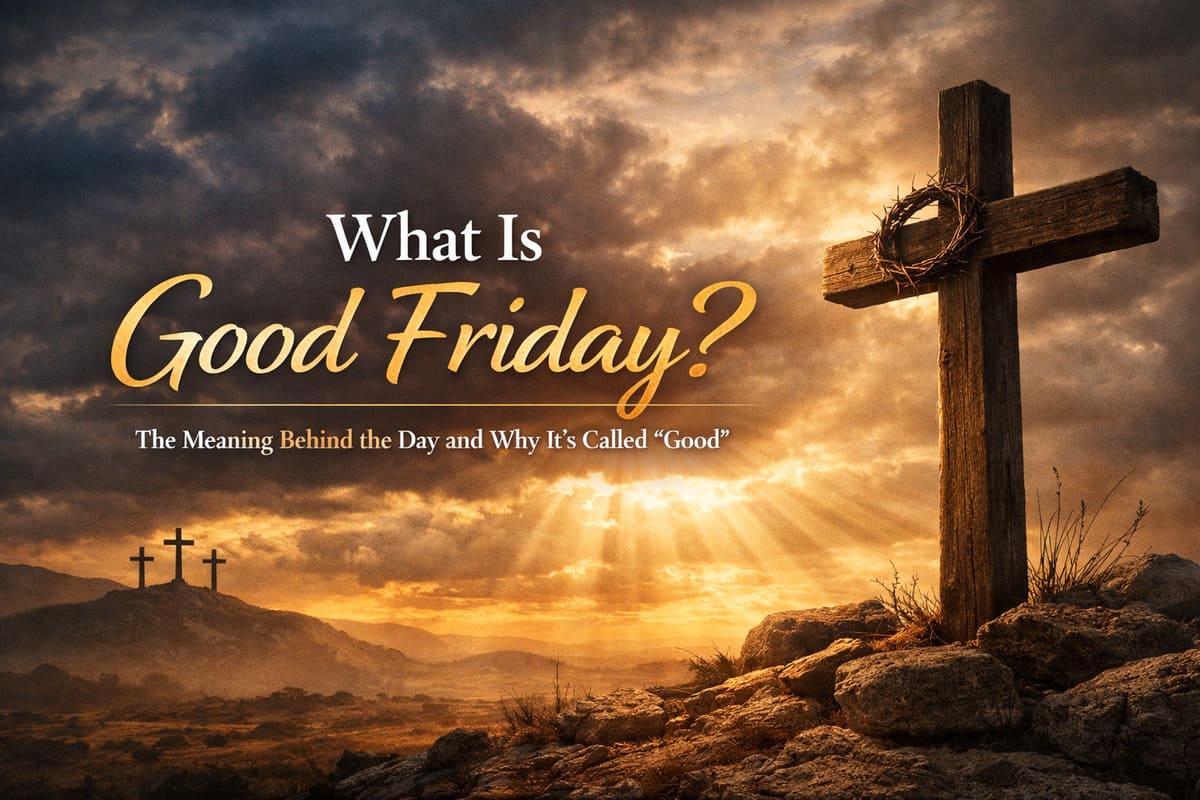
Good Friday is the Friday before Easter Sunday when Christians remember the crucifixion and death of Jesus Christ.
Although the day recalls suffering, injustice and death, Christians call it “good” because they believe Jesus’ sacrifice opened the way for forgiveness, reconciliation with God and the hope celebrated at Easter.
Good Friday is therefore a solemn day rather than a festive one. Churches and individuals often observe it through Scripture reading, prayer, worship, fasting and quiet reflection on the death of Christ.
Good Friday at a Glance
| Question | Answer |
|---|---|
| What is Good Friday? | The Christian remembrance of Jesus Christ’s crucifixion and death |
| When is it observed? | On the Friday before Easter Sunday |
| Why is it called good? | Because Christians believe Christ’s death brought redemption, forgiveness and hope |
| Where is the story found? | Matthew 26–27, Mark 14–15, Luke 22–23 and John 18–19 |
| What comes after it? | Holy Saturday and Easter Sunday, which celebrates the resurrection of Jesus |
What Is Good Friday?
Good Friday is an important day in the Christian calendar devoted to remembering the suffering, crucifixion and death of Jesus Christ.
The Gospel accounts describe Jesus being arrested after praying in the Garden of Gethsemane, questioned by religious authorities, brought before the Roman governor Pontius Pilate and sentenced to death by crucifixion.
Jesus was taken to Golgotha, also called Calvary, where He was crucified. After His death, His body was placed in a tomb before the Sabbath began.
You can read the central accounts in:
- Matthew 26 and Matthew 27
- Mark 14 and Mark 15
- Luke 22 and Luke 23
- John 18 and John 19
The Bible does not use the modern name Good Friday. The name developed within Christian tradition as the Church established an annual period for remembering the final days, death and resurrection of Jesus.
What Happened on Good Friday?
The events remembered on Good Friday form part of the final period of Jesus’ earthly ministry, often called the Passion of Christ.
Jesus Prayed in Gethsemane
After sharing a final meal with His disciples, Jesus went to the Garden of Gethsemane to pray. He knew that suffering was approaching and prayed in deep anguish while submitting Himself to the Father’s will.
The disciples struggled to remain awake, and Judas Iscariot later arrived with those who had come to arrest Jesus.
Jesus Was Arrested and Questioned
Jesus was taken before Jewish religious authorities and later brought before Pontius Pilate. The Gospel accounts describe accusations, questioning, public pressure and Pilate’s eventual decision to authorise the crucifixion.
Jesus was mocked, beaten and given a crown of thorns before being led towards the place of execution.
Jesus Was Crucified at Golgotha
Jesus was crucified at a place called Golgotha, meaning the place of a skull. He was placed on a cross between two other condemned men.
The Gospels record several statements Jesus made while on the cross, including words of forgiveness, care, anguish and trust. John records His final declaration:
“It is finished.” — John 19:30
Christians understand these words as expressing the completion of the mission Jesus had willingly accepted.
Jesus Died and Was Buried
After Jesus died, Joseph of Arimathaea requested His body from Pilate. Jesus was wrapped and placed in a tomb before the Sabbath.
Good Friday ends with Jesus in the tomb. The Christian story then continues through Holy Saturday to Easter Sunday, when Christians celebrate His resurrection.
Why Is It Called Good Friday?
The name can appear confusing because Good Friday remembers suffering and death rather than an event that felt pleasant or happy.
The exact linguistic history of the English name is not completely certain. The word good may carry an older sense connected with holiness or religious observance. The day is also known in different Christian traditions as Holy Friday, Great Friday, Great and Holy Friday or the Friday of the Passion.
Its Christian meaning is clearer: the day is called good because of what believers understand Jesus’ death to have accomplished.
- Jesus willingly gave His life in love.
- His death dealt with humanity’s sin and separation from God.
- Forgiveness and reconciliation became available through Christ.
- The crucifixion prepared the way for the resurrection celebrated at Easter.
Christians are not saying that betrayal, injustice, suffering or execution were good in themselves. The word points instead to God bringing redemption and hope from an event marked by human wrongdoing and sorrow.
The Meaning of Good Friday in Christianity
Good Friday is central to Christian faith because the crucifixion is closely connected with the message of salvation.
The Love of God
Christians see the cross as a demonstration of God’s love. Jesus did not merely teach about sacrificial love; He willingly accepted suffering and death for the sake of others.
Romans 5:8 states that God demonstrated His love towards humanity while people were still sinners.
Sin and Forgiveness
The New Testament teaches that sin separates people from God and that forgiveness cannot be earned through human goodness alone.
Christian traditions explain different aspects of the atonement in different ways, but broadly agree that the death of Jesus is central to forgiveness, salvation and reconciliation with God.
Sacrifice and Reconciliation
The New Testament describes Jesus as giving His life for others and compares His death with the sacrificial themes found throughout Scripture.
Through Christ, believers understand that peace with God is possible and that people from different backgrounds can be brought into one reconciled community.
Hope Beyond Suffering
Good Friday does not deny the reality of suffering. It faces betrayal, injustice, grief and death directly.
At the same time, it is not the conclusion of the Christian story. Good Friday points towards the resurrection, teaching Christians that suffering and death do not have the final word.
A Brief History of Good Friday
From the earliest period of Christianity, the death and resurrection of Jesus stood at the centre of Christian preaching and worship. The New Testament letters and Gospel accounts repeatedly return to the crucifixion as a defining event.
As Christian worship developed, churches established annual observances connected with the final week of Jesus’ life. The Friday before Easter became a particular day for remembering His Passion and death.
Different Christian traditions developed their own names, services and customs. Western churches commonly use the name Good Friday, while Eastern Orthodox Christians generally refer to the day as Great and Holy Friday.
The forms of observance vary, but the central focus remains the same: remembering the crucifixion of Jesus and reflecting on its meaning.
Why Does the Date of Good Friday Change?
Good Friday does not fall on the same calendar date every year because its date is determined by Easter Sunday.
It is always observed on the Friday immediately before Easter. Since the date of Easter changes from year to year, the date of Good Friday changes with it.
There can also be differences between Western and Eastern Christian calendars, meaning that not every Christian tradition observes Easter and Good Friday on the same civil date each year.
How Christians Observe Good Friday
Good Friday practices differ between denominations, cultures and individual believers. Common observances include:
Church Services
Many churches hold solemn services centred on the Gospel accounts of Jesus’ arrest, trial, crucifixion and death.
Services may include hymns, prayers, preaching, silence and readings from the Passion narratives.
Prayer and Quiet Reflection
Christians may spend time reflecting on the cross, confessing sin, expressing gratitude and considering how Christ’s example should shape their lives.
Fasting and Abstinence
Some Christian traditions practise fasting or abstain from particular foods on Good Friday. These practices are intended to support prayer, repentance and remembrance rather than to earn forgiveness.
The specific expectations differ by denomination, and many Protestant communities do not require a formal Good Friday fast.
The Stations of the Cross
Some churches use the Stations of the Cross, a series of prayers and reflections following events associated with Jesus’ journey towards crucifixion.
The Seven Last Words of Jesus
Some congregations hold services built around seven statements attributed to Jesus across the four Gospel accounts while He was on the cross.
Tenebrae Services
A Tenebrae service uses Scripture, prayer and the gradual darkening of the worship space to reflect the sorrow and darkness surrounding the Passion of Christ.
How to Observe Good Friday at Home
A formal church service is not the only way to observe the day. Personal practices may include:
- Reading one of the Gospel crucifixion accounts slowly.
- Spending time in quiet prayer and confession.
- Thanking Jesus for His sacrifice.
- Reflecting on forgiveness, reconciliation and sacrificial love.
- Reducing ordinary entertainment to create space for reflection.
- Offering practical help, generosity or compassion to someone in need.
- Preparing spiritually for the celebration of Easter Sunday.
A Prayer for Good Friday
Lord Jesus, on this Good Friday, help me remember the depth of Your love and the cost of the cross.
Give me humility to recognise my need for grace, courage to turn away from sin and willingness to forgive as I have been forgiven.
Teach me to follow Your example through compassion, truth, service and sacrificial love. As I remember Your death, keep my heart anchored in the hope of Your resurrection. Amen.
Good Friday Questions
Why do Christians celebrate Good Friday?
Christians observe Good Friday to remember the crucifixion and death of Jesus Christ. The word celebrate can be misleading because the day is usually solemn rather than festive. It is more accurately described as a commemoration or observance.
Why is Good Friday called good when Jesus died?
It is called good because Christians believe Jesus’ death brought forgiveness, reconciliation and the hope of salvation. The suffering itself was not good, but believers see God bringing redemptive good from it.
Is Good Friday mentioned in the Bible?
The name Good Friday does not appear in the Bible. However, the events it commemorates are described in all four Gospels.
Why is Good Friday observed on a Friday?
The Gospel accounts place Jesus’ death and burial on the day before the Jewish Sabbath. Christian tradition therefore commemorates the crucifixion on Friday and the resurrection on Sunday.
Is Good Friday a happy day?
Good Friday is not normally treated as a happy or festive day. It is solemn because it remembers suffering and death, but it also contains hope because Christians know that Easter follows.
What is the difference between Good Friday and Easter?
Good Friday remembers the crucifixion and death of Jesus. Easter Sunday celebrates His resurrection from the dead. The two observances are distinct but inseparably connected within Christian faith.
Do all Christians fast on Good Friday?
No. Some Christian traditions require or encourage fasting and abstinence, while others leave the decision to individual believers. Fasting should support prayer and reflection rather than become a way of judging others.
What does Good Friday represent?
Good Friday represents the sacrificial death of Jesus, the seriousness of sin, God’s love, the offer of forgiveness and the hope that leads towards the resurrection.
Remembering the Cross and Looking Towards Easter
Good Friday invites Christians to pause before moving quickly to the celebration of Easter. It creates space to consider the suffering of Jesus, the meaning of His sacrifice and the depth of God’s love.
The day is solemn because the crucifixion was real and painful. It is called good because Christians believe that through the cross came forgiveness, reconciliation and enduring hope.
Read the full crucifixion accounts through the Jesusfully online Bible, or explore more Christian articles and Bible guides.