The 10 Commandments in Order According to the Bible (Simple Explanations)
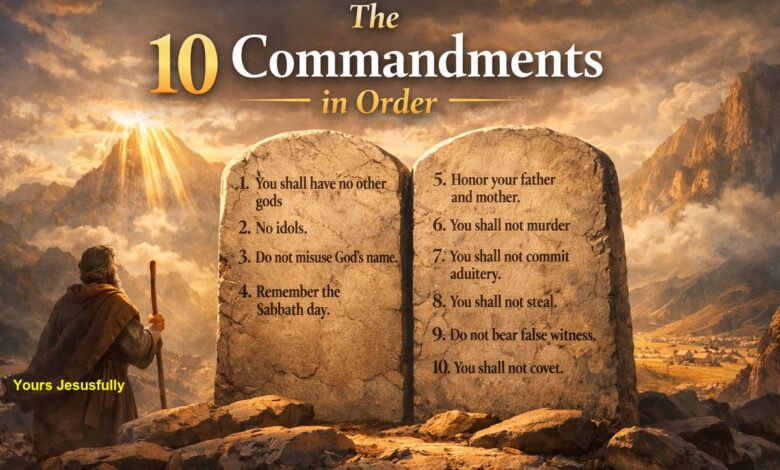
If you want to know the 10 Commandments in order and understand what each one means, you’re in the right place. Here’s a simple, clear list you can follow:
The 10 Commandments in order are:
- You shall have no other gods before Me
- You shall not make idols
- You shall not take the Lord’s name in vain
- Remember the Sabbath day and keep it holy
- Honor your father and mother
- You shall not murder
- You shall not commit adultery
- You shall not steal
- You shall not bear false witness
- You shall not covet
Below, you will find a full explanation of each commandment in simple language, including why the order matters and how they still apply today.
The Ten Commandments are some of the most important teachings in the Bible. Even people who don’t regularly read the Bible have heard about them. For a very long time, these commandments have helped people understand how to live well, treat others kindly, and stay connected to God.
If you are looking for the 10 Commandments in order, this guide is written especially for you. It explains each commandment in a clear and simple way, without complicated words or confusing ideas. The goal is to help you not only know what the commandments are, but also understand why they matter and how they can be used in everyday life.
The Ten Commandments are not old rules that no longer apply. Even though they were given thousands of years ago, they still speak to the kinds of choices people face today. They give practical guidance that can bring peace, direction, and wisdom into daily life.
What Are the Ten Commandments?
The Ten Commandments are laws that God gave to Moses after freeing the Israelites from slavery in Egypt. You can find this story in the Bible in Exodus 20 and again in Deuteronomy 5. The Bible tells us that God spoke these commandments and wrote them on stone tablets to show how important they were.
These commandments were given to help people live the right way. They show us how to honor God and how to treat other people with love and respect. They are not meant to make life harder. Instead, they are meant to protect us from harmful choices and guide us toward a better life.
The commandments are also organized in a helpful way. The first four focus on our relationship with God. The remaining six focus on how we relate to other people. Together, they give us a simple guide for living a good and meaningful life.
The 10 Commandments in Order (According to the Bible)
Here are the 10 Commandments in order, just as they appear in the Bible. Each one is explained in a simple way, with examples you can easily relate to.
1. You Shall Have No Other Gods Before Me
This commandment means that God should come first in our lives. Nothing else should be more important to us than Him.
Today, it’s easy to let other things take God’s place. This could be money, work, relationships, social media, or entertainment. When we give too much time and attention to something else and forget God, that thing can slowly become more important than it should be.
Putting God first can be as simple as praying, thanking Him daily, or thinking about His guidance when making decisions.
2. You Shall Not Make for Yourself an Idol
This commandment teaches us not to worship anything other than God. In Bible times, people made statues to worship, but today idols usually look very different.
An idol can be anything we trust more than God or depend on for happiness and security. This might include money, success, popularity, or even our phones. God wants us to depend on Him, not on things that can easily fade or fail.
Taking time away from distractions can help us refocus on what truly matters.
3. You Shall Not Take the Name of the Lord Your God in Vain
This commandment reminds us to respect God’s name. It means we should not use God’s name carelessly or disrespectfully.
Using God’s name in anger, as a joke, or without meaning takes away from its holiness. It also reminds us to be sincere when we talk about God and to live in a way that matches our faith.
4. Remember the Sabbath Day, to Keep It Holy
God gave us the Sabbath as a day to rest and focus on Him. This commandment reminds us that rest is important.
Life can be very busy, and many people feel tired all the time. God knows this, which is why He encourages us to slow down. Taking time to rest, pray, worship, and spend time with loved ones helps renew our strength.
5. Honor Your Father and Your Mother
This commandment teaches us to respect and care for our parents. Honoring parents helps build strong families and healthy relationships.
Even when parents make mistakes or disagreements happen, showing respect, gratitude, and kindness still matters. Helping them, listening to them, and appreciating their efforts are simple ways to live out this commandment.
6. You Shall Not Murder
God values human life deeply, and this commandment protects life. It clearly teaches that harming or killing others is wrong.
It also reminds us to watch our attitudes. Anger, hatred, and bitterness can hurt people even without physical harm. Choosing forgiveness, patience, and kindness reflects God’s care for life.
7. You Shall Not Commit Adultery
This commandment is about faithfulness in marriage. It reminds us to respect the promises made between husband and wife.
Marriage is meant to be built on trust and commitment. Being faithful helps protect families and keeps relationships strong and healthy.
8. You Shall Not Steal
This commandment teaches honesty. It tells us not to take what does not belong to us.
Stealing can also include cheating, lying for personal gain, or taking credit for someone else’s work. God wants us to live fairly and honestly in everything we do.
9. You Shall Not Bear False Witness Against Your Neighbor
This commandment is about telling the truth. It warns against lying, gossiping, or spreading false information about others.
Words are powerful. Speaking truthfully and kindly helps protect relationships and builds trust, especially in today’s world where rumors spread easily.
10. You Shall Not Covet
Coveting means wanting what someone else has in a way that causes jealousy or discontent.
This commandment teaches us to be thankful for what we have. Constant comparison can make us unhappy, but gratitude helps us find peace and joy in God’s blessings.
Are the Ten Commandments Still Relevant Today?
Yes, the Ten Commandments are still very important today. Even though the world has changed, people still face the same struggles—dishonesty, jealousy, broken relationships, and misplaced priorities.
The Ten Commandments give clear guidance for handling these challenges. Many Christians see them not as a way to earn God’s love, but as a guide for living a life that honors Him.
A Gentle Note on Catholic and Protestant Numbering
If you have ever noticed that Catholics and Protestants sometimes list the Ten Commandments a little differently, you are not alone. This can be confusing for people searching for the 10 Commandments in order, but the difference is mostly about grouping, not meaning.
Both Catholic and Protestant traditions use the same biblical passages in Exodus 20 and Deuteronomy 5. The teachings themselves are the same. What changes is how certain commandments are divided or combined when they are numbered.
For example, many Protestant lists separate “having other gods” and “making idols” into two commandments, while Catholic lists combine them into one. To keep the total at ten, the final commandment about coveting is sometimes divided into two parts in Catholic tradition.
It is important to remember that no tradition removes or adds any commandments. The core message, loving God and loving others, remains exactly the same. This article focuses on the biblical order and meaning, not on promoting one tradition over another.
Frequently Asked Questions About the Ten Commandments
Where are the 10 Commandments found in the Bible?
The Ten Commandments appear in Exodus 20 and are repeated in Deuteronomy 5. These two passages contain the full list in order as given by God to Moses.
Why are there different numberings of the Ten Commandments?
Some Christian traditions group or phrase the commandments slightly differently, but the core teachings remain the same. This article follows the commonly accepted biblical order found in Exodus 20.
Did Jesus support the Ten Commandments?
Yes. Jesus affirmed the importance of God’s commandments and taught that loving God and loving others fulfills their purpose.
Are Christians required to follow the Ten Commandments today?
Many Christians view the Ten Commandments as moral guidance that shows how to live wisely and honor God, not as a way to earn salvation.
Final Thoughts
Understanding the 10 Commandments in order helps us see God’s loving guidance more clearly. These commandments were given to help, not to burden.
They encourage us to love God, respect others, and make wise choices. Even today, they continue to guide people toward lives filled with peace, integrity, and purpose.
Whether you are learning about them for the first time or revisiting them, the Ten Commandments remain a simple and powerful guide for living a life rooted in faith.
Just like the 10 commandments help us live the way God wants, prayer is another way to grow closer to Him. If you want to learn more about talking to God, check out our guide on How to Pray to God.