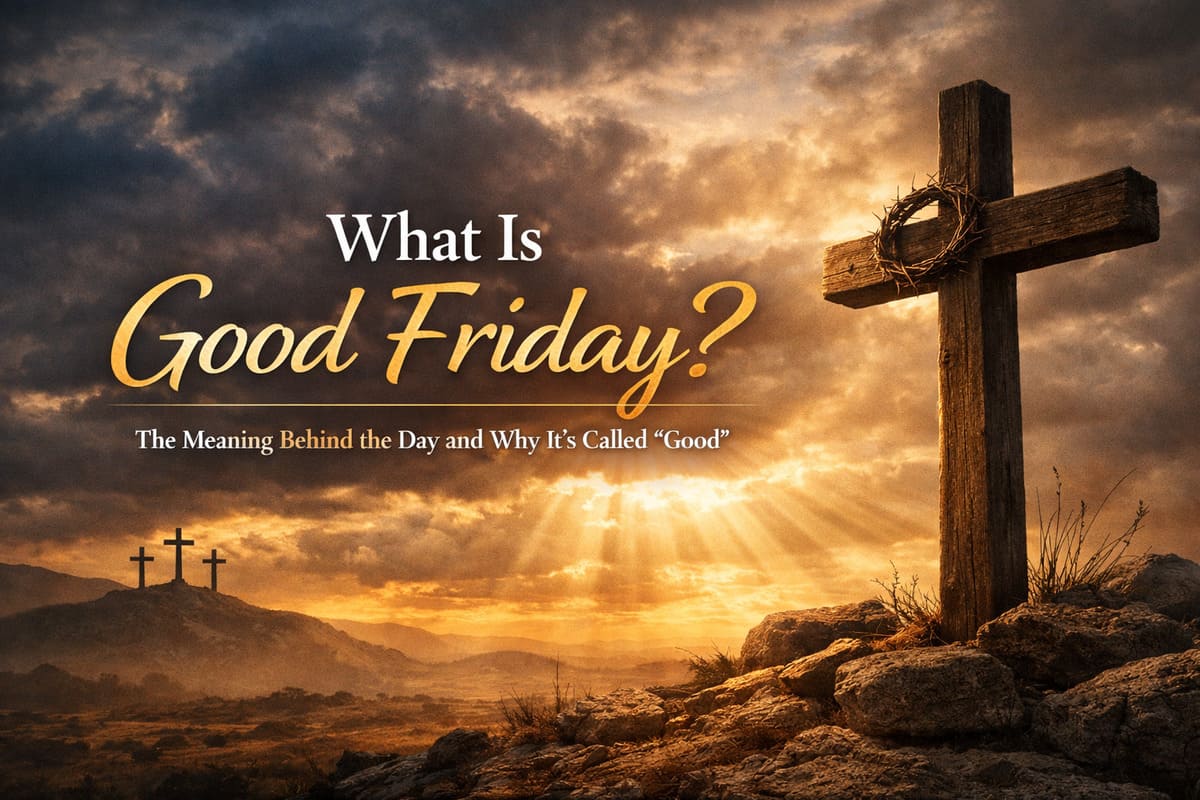
Every year around Easter, many people hear about Good Friday. It appears on calendars, churches hold special services, and in some places, it’s even a public holiday. But for many, one question keeps coming up: What is Good Friday, and why is it called “good”?
It’s an honest question — especially when you learn that Good Friday remembers the day Jesus Christ died on the cross. That doesn’t sound like a “good” event at all. So why is it called Good Friday when Jesus died?
If you’ve ever wondered about that, you’re not alone.
In this post, we’ll explain what Good Friday is, what happened on that day, why it’s called Good Friday, and why Christians around the world still consider it deeply meaningful today — even though it began with pain and sorrow.
What Is Good Friday?
Good Friday is the Friday before Easter Sunday, and it is one of the most important days in the Christian calendar.
It is the day Christians remember the crucifixion of Jesus Christ. According to the Bible, Jesus was arrested, put on trial, and sentenced to death by crucifixion, a harsh form of execution used by the Roman Empire at the time.
On that day, Jesus was beaten, mocked, and made to carry a wooden cross to a place called Golgotha (also known as Calvary). There, he was nailed to the cross and later died.
While this was a painful and heartbreaking event, Christians believe it was not meaningless. Instead, they believe it was part of God’s plan for humanity — a plan that didn’t end on Friday.
Why Is It Called Good Friday?
This leads to one of the most common questions people ask:
Why is it called Good Friday when Jesus died?
At first glance, the name does seem confusing. After all, Good Friday marks a day of suffering, injustice, and death. There was nothing “happy” about it.
The key is understanding what the word “good” means in this context.
The word doesn’t mean pleasant or joyful. Instead, it points to the outcome of that day, not the pain of it. Christians believe that Jesus willingly died as a sacrifice so that humanity could be forgiven and restored in relationship with God.
In simple terms, Christians believe:
- Jesus’ death made forgiveness possible
- His sacrifice showed deep love
- His death was followed by resurrection and new life
So while Good Friday is a solemn and quiet day, it is called “good” because of the hope and redemption that came from it.
That’s the heart of the answer to why it is called Good Friday.
The History of Good Friday
To really understand Good Friday, we need to take a step back and look at the history behind it.
The story begins with Jesus, a Jewish teacher who lived about 2,000 years ago in what is now Israel. He traveled around, teaching about love, forgiveness, and the Kingdom of God.
He also performed miracles, like healing the sick and feeding the hungry, which drew large crowds.
But not everyone was happy with Jesus. His teachings challenged the religious and political leaders of the time, and they saw him as a threat.
Eventually, he was arrested, put on trial, and sentenced to death by crucifixion—a common punishment for criminals in the Roman Empire.
The crucifixion took place on a Friday, and Christians believe it happened around the time of the Jewish Passover, a major religious festival.
After Jesus died, his body was taken down from the cross and placed in a tomb. But according to the Bible, that wasn’t the end of the story.
Three days later, on Easter Sunday, Jesus rose from the dead, an event Christians celebrate as the Resurrection.
Over the centuries, Good Friday became an important day of remembrance for Christians. Different traditions and customs developed around the world, from fasting and prayer to reenactments of Jesus’ journey to the cross.
Today, it’s observed by millions of people as a day of reflection, gratitude, and hope.
The Events Leading to Good Friday
To fully grasp the significance of Good Friday, it’s important to understand the key events that led up to Jesus’ crucifixion. These events are central to the story and help explain why this day holds such deep meaning for Christians.
1. The Last Supper and Betrayal
The events leading to Good Friday begin with the Last Supper, which took place on the evening of Maundy Thursday. Jesus gathered his disciples for a final meal, where he shared bread and wine with them, an act later known as the Eucharist or Holy Communion. During this meal, Jesus predicted his betrayal by one of his closest followers, Judas Iscariot.
This moment is significant because it marks the beginning of Jesus’ journey to the cross. It’s also a powerful reminder of themes like loyalty, sacrifice, and the importance of remembering Jesus’ teachings.
2. The Arrest and Trials of Jesus
After the Last Supper, Jesus went to the Garden of Gethsemane to pray. It was here that Judas betrayed him with a kiss, signaling to the Roman soldiers who Jesus was. Jesus was arrested and taken to a series of trials before Jewish and Roman authorities.
Despite finding no fault in him, Pontius Pilate, the Roman governor, succumbed to public pressure and sentenced Jesus to be crucified. This part of the story highlights the injustice and political tension of the time, as well as Jesus’ willingness to endure suffering for a greater purpose.
3. The Crucifixion
The crucifixion of Jesus is the central event commemorated on Good Friday. Jesus was forced to carry his cross to the place of execution, Golgotha, also known as Calvary. Here, he was nailed to the cross and left to die alongside two criminals. The sky darkened, and Jesus uttered his final words before giving up his spirit.
This moment is both heartbreaking and profound. For Christians, it represents the ultimate sacrifice—a demonstration of love so deep that Jesus was willing to lay down his life for others.
The Meaning of Good Friday: Why It Matters
So, beyond history, what does Good Friday mean today?
For Christians, it’s a day to remember the ultimate sacrifice Jesus made out of love for humanity. It’s a reminder that even in the darkest moments, there’s hope for redemption and new beginnings.
Here are a few key themes that make Good Friday meaningful:
- Sacrifice: Christians believe Jesus willingly gave his life to save others. His death is seen as the ultimate act of love and selflessness.
- Forgiveness: Through his death, Christians believe Jesus made it possible for people to be forgiven for their sins and reconciled with God.
- Hope: While Good Friday is a day of mourning, it’s also a day of hope. It points forward to Easter Sunday, when Jesus rose from the dead, showing that death isn’t the end.
This is why Good Friday, though quiet and reflective, holds deep meaning.
How Is Good Friday Observed? Traditions and Practices
Different Christian traditions observe Good Friday in unique ways, but there are some common practices that unite many believers. Here’s a closer look at how Good Friday is observed around the world:
1. Church Services
On Good Friday, many Christian denominations hold solemn services to remember the crucifixion of Jesus. These services often include readings from the Passion narratives in the Gospels, prayers, hymns, and moments of silence. Some traditions observe the Stations of the Cross, a series of 14 devotions that depict the final hours of Jesus’ life.
2. Fasting and Abstinence
Fasting and abstinence are common practices on Good Friday. Many Christians abstain from meat and limit their food intake as a form of penance. This act of self-denial is a way to participate in the suffering of Jesus and to reflect on his sacrifice.
3. The Veneration of the Cross
In some traditions, the veneration of the cross is a central part of Good Friday observances. This involves the faithful approaching a cross or crucifix to kiss it or touch it, showing reverence and gratitude for the sacrifice of Jesus.
4. The Tenebrae Service
The Tenebrae service, which means “darkness” or “shadows” in Latin, is a tradition observed by some Christian communities. It involves the gradual extinguishing of candles to symbolize the abandonment of Jesus by his disciples and the darkness that covered the earth during his crucifixion. The service often concludes in darkness, representing the death and burial of Jesus.
Good Friday Around the World: Regional Customs
Good Friday is observed differently across cultures, with unique customs and traditions that reflect local beliefs and practices. Here are a few examples:
Western Christianity
In Western Christianity, including the Roman Catholic Church and many Protestant denominations, Good Friday is a day of mourning and reflection. Special liturgies and services are held, and the faithful are encouraged to meditate on the Passion of Christ.
Eastern Orthodoxy
In Eastern Orthodox Christianity, Good Friday is known as Great and Holy Friday. The day is marked with strict fasting, lengthy services, and processions. The events of Jesus’ Passion are recounted in detail, and the faithful participate in various acts of devotion.
Regional Customs
Different cultures have unique customs associated with Good Friday. For example:
- In the Philippines, some devotees symbolically reenact aspects of the crucifixion as an act of penance.
- In Spain, elaborate processions featuring statues of Jesus and Mary are held.
- In Mexico, communities often stage dramatic reenactments of the Passion story.
These diverse traditions highlight the universal significance of Good Friday while showcasing the beauty of cultural expression.
Why Good Friday Is Still Relevant Today
Even for people who are not religious, the story of Good Friday has some powerful lessons that can resonate with anyone. It’s a story about love, sacrifice, and the idea that even in our darkest moments, there’s hope for something better.
In a world where we often focus on success, wealth, and power, Good Friday reminds us of the value of humility, compassion, and selflessness.
It’s a day to pause and think about what really matters in life—and how we can make a positive difference in the world.
Final Thoughts: What Makes Good Friday “Good”?
So, what is Good Friday really about?
It’s a day that remembers pain, but also points to hope. It remembers loss, but also points to new life. And that’s why Christians continue to observe it with reverence and gratitude.
Why is it called Good Friday when Jesus died?
Because Christians believe that through that sacrifice came forgiveness, redemption, and hope for the future.
Good Friday may begin with sorrow, but its meaning doesn’t end there — and that’s what makes it truly “good.”