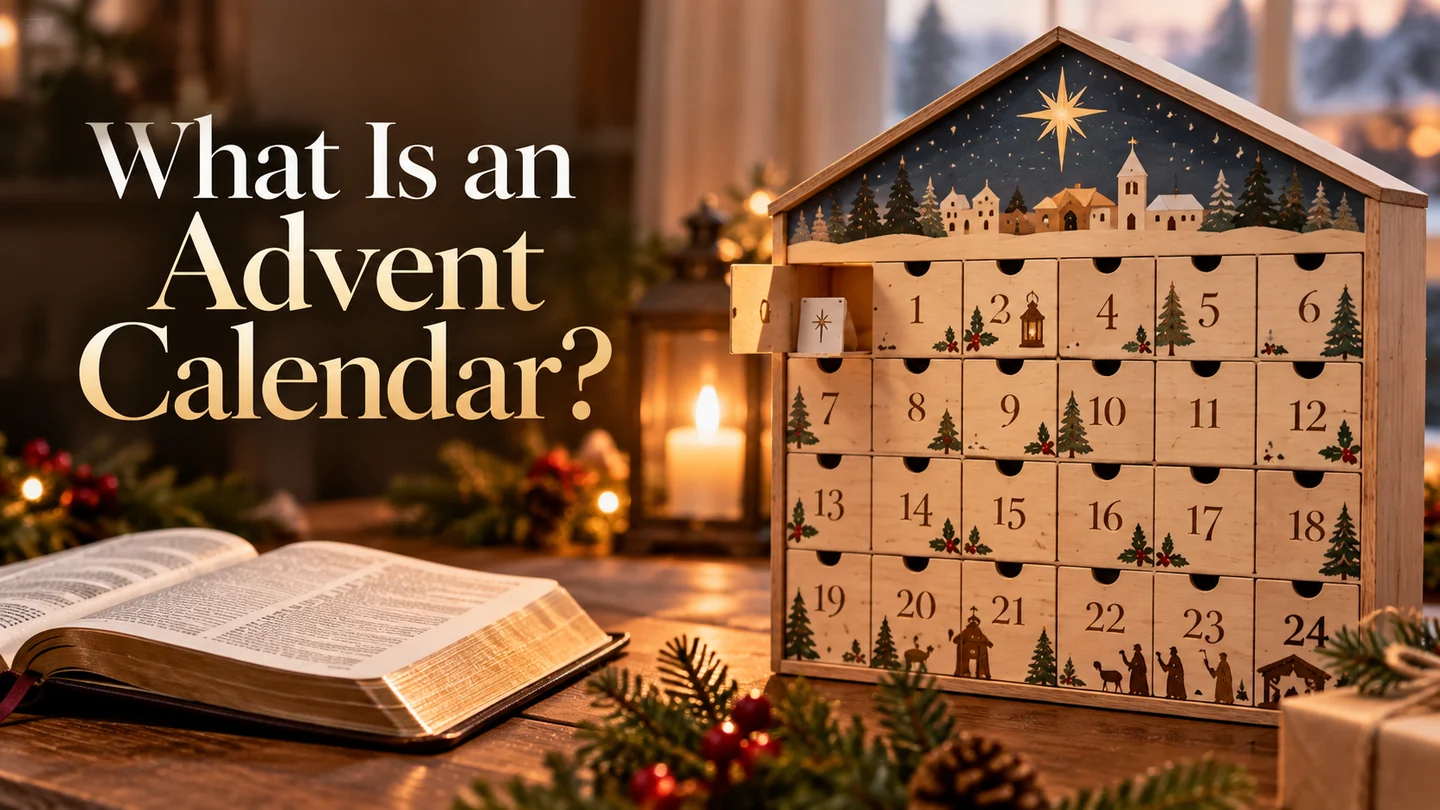
An Advent calendar is a simple way of counting the days leading up to Christmas. Most calendars have 24 numbered doors, pockets or compartments. Beginning on December 1, one is opened each day until Christmas Eve.
Some contain chocolate or small gifts. Others reveal a picture, Bible verse, prayer prompt or family activity.
For Christians, an Advent calendar can be more than a December countdown. Used thoughtfully, it can create a small daily pause to read Scripture, pray and remember why Christmas is celebrated.
But an Advent calendar and the Christian season of Advent are not exactly the same thing. They overlap, but they follow different calendars. Understanding that difference makes the tradition much easier to explain.
What Is an Advent Calendar?
An Advent calendar is a daily countdown to Christmas. The standard modern version begins on December 1 and ends on December 24.
The calendar may be made from card, wood, fabric or small boxes. The important feature is that each day is marked separately so that the waiting becomes visible.
Traditional Christian calendars often revealed a Bible verse, a nativity picture or another reminder of the Christmas story. Modern versions may contain sweets, toys, beauty products, tea, stationery or almost anything else that can fit behind a small door.
The object has changed considerably over time, but the basic idea is still simple: one day, one opening, one step closer to Christmas.
How Does an Advent Calendar Work?
Most people begin with door number 1 on December 1. On December 2 they open number 2, and continue until number 24 on Christmas Eve.
Some calendars include a twenty-fifth compartment for Christmas Day. Others follow a different family pattern. There is no Christian rule requiring a particular commercial format.
If you are using the calendar devotionally, the daily opening can be paired with something small: read a short passage, say a prayer, talk about the Christmas story or choose an act of kindness for the day.
Is an Advent Calendar the Same as Advent?
No. This is one of the most common points of confusion.
The Christian season of Advent begins on the fourth Sunday before Christmas. Its starting date therefore changes from year to year.
An Advent calendar normally begins on the fixed date of December 1.
In 2026, for example, the Western Christian season of Advent begins on Sunday, November 29. A standard Advent calendar begins two days later on Tuesday, December 1.
The calendar borrows its name and sense of anticipation from Advent, but it is not the liturgical season itself.
Where Did Advent Calendars Come From?
The tradition developed in German-speaking Christian homes during the nineteenth century.
Before printed calendars became common, families used simple ways of marking the days before Christmas. Some made chalk marks on a door or wall. Others displayed a new devotional picture each day, lit candles or used other small household practices to make the waiting visible to children.
Printed calendars appeared around the beginning of the twentieth century. Gerhard Lang is frequently associated with the early commercial development of the Advent calendar. His childhood experience of receiving a homemade countdown from his mother is often connected with the calendars he later helped publish.
Early printed versions did not necessarily contain sweets. Many used pictures or devotional material. The familiar doors that open to reveal something behind them became popular later.
After the disruptions of the Second World War, Advent calendars spread more widely beyond Germany. Over time, chocolate and gift-filled versions became especially popular.
This history explains why the calendar is both a Christian-season tradition and, in many homes today, a largely cultural Christmas activity.
Are Advent Calendars Biblical?
The Bible does not mention Advent calendars and does not command Christians to use one.
The calendar is a later tradition. Its value depends on how it is used.
A family may use one simply for fun. Another family may use it as a daily reminder to read Scripture. Neither the cardboard, the numbered doors nor the chocolate carries spiritual power.
For Christians who want the calendar to support their faith, the most useful question is not “Is this object in the Bible?” but “Can this ordinary tradition help us make room for Scripture, prayer, gratitude and generosity?”
What Can You Put in a Christian Advent Calendar?
You do not need expensive gifts behind every door.
- A short Bible passage
- A one-sentence prayer prompt
- A question for family discussion
- A simple act of kindness
- A note of gratitude
- A small sweet or treat
- A reminder to contact someone who may be lonely
- A Christmas hymn to listen to together
- A small family activity
You can also combine something enjoyable with something reflective. A child can receive a sweet and still read a verse. The two are not in competition.
A 24-Day Scripture Advent Calendar
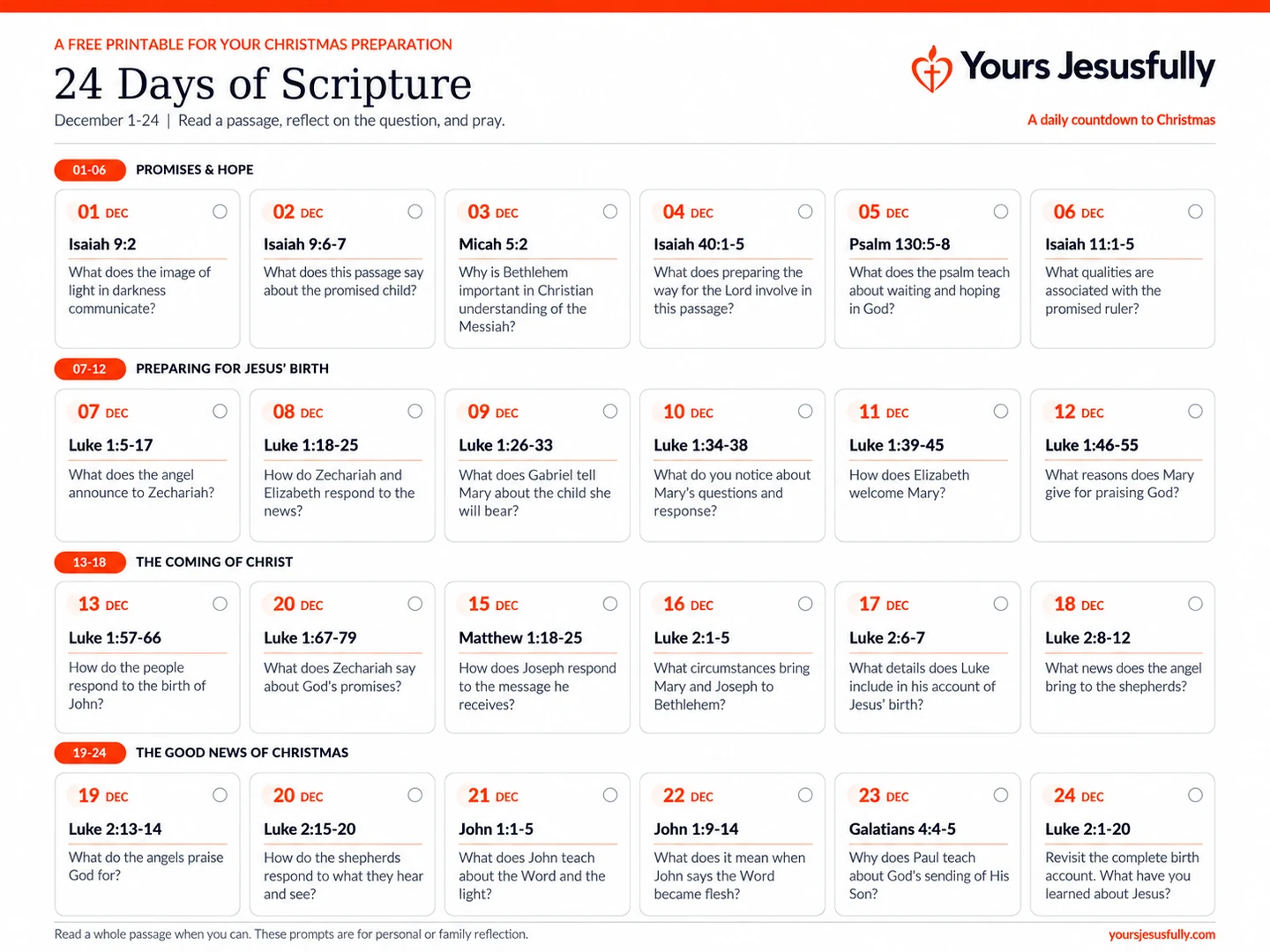
If you want to make your own Christian calendar, the following plan moves from Old Testament promises into the Gospel accounts of Jesus’ birth.
You can place one passage behind each numbered door or simply print the list and read one entry each day.
| Day | Reading | Reflection |
|---|---|---|
| 1 | Isaiah 9:2 | What does the image of light communicate? |
| 2 | Isaiah 9:6–7 | What does this passage say about the promised ruler? |
| 3 | Micah 5:2 | Why is Bethlehem important in the biblical story? |
| 4 | Isaiah 40:1–5 | What does preparing the way for the Lord mean in this passage? |
| 5 | Psalm 130:5–8 | What does the psalm teach about waiting and hoping in God? |
| 6 | Isaiah 11:1–5 | What qualities are associated with the promised ruler? |
| 7 | Luke 1:5–17 | What does the angel announce about John? |
| 8 | Luke 1:18–25 | How do Zechariah and Elizabeth respond to the news? |
| 9 | Luke 1:26–33 | What does Gabriel tell Mary about her child? |
| 10 | Luke 1:34–38 | What do you notice about Mary’s response? |
| 11 | Luke 1:39–45 | What happens when Mary visits Elizabeth? |
| 12 | Luke 1:46–55 | What does Mary praise God for? |
| 13 | Luke 1:57–66 | How do the people respond to John’s birth? |
| 14 | Luke 1:67–79 | What does Zechariah say God is doing? |
| 15 | Matthew 1:18–25 | How does Joseph respond to the message he receives? |
| 16 | Luke 2:1–5 | What circumstances bring Joseph and Mary to Bethlehem? |
| 17 | Luke 2:6–7 | How simply does Luke describe Jesus’ birth? |
| 18 | Luke 2:8–12 | What message does the angel give the shepherds? |
| 19 | Luke 2:13–14 | What do the angels praise God for? |
| 20 | Luke 2:15–20 | How do the shepherds respond after seeing Jesus? |
| 21 | John 1:1–5 | What does John say about the Word, life and light? |
| 22 | John 1:9–14 | What does it mean that the Word became flesh? |
| 23 | Galatians 4:4–5 | How does Paul describe the timing and purpose of Christ’s coming? |
| 24 | Luke 2:1–20 | Read the whole birth account and note one thing you want to remember. |
How to Make a Simple Advent Calendar at Home
You can make one without buying a craft kit.
Use 24 envelopes, folded cards, small paper bags or boxes. Number them 1 through 24. Add the daily Scripture reference and, if you want, a short question or activity.
Hang the envelopes on string, place them in a basket or arrange them on a table.
If the project begins to feel more stressful than helpful, simplify it. A printed list on the fridge can serve the same purpose. The calendar is meant to help you prepare, not create another December obligation.
Using an Advent Calendar With Children
Children often enjoy the physical act of opening something each day, which makes the calendar a useful opportunity for short conversations.
Keep the reading realistic for their age. A younger child may listen to two or three verses and answer one simple question. Older children can read a longer passage and discuss what it means.
Try not to turn every door into a lesson that has to be perfect. Some days will be rushed. Some children will care more about the chocolate than the reflection. Consistency matters more than creating an ideal devotional moment every morning.
Over time, the repeated rhythm can help the Christmas story become familiar.
Advent Calendar and Advent Wreath: What Is the Difference?
| Advent calendar | Advent wreath |
|---|---|
| Usually begins December 1. | Follows the four Sundays of Advent. |
| Usually has 24 daily doors, pockets or entries. | Usually has four candles, sometimes with a fifth Christ candle. |
| Can be religious or entirely secular. | Most commonly used as a Christian devotional symbol. |
| Marks each day leading to Christmas Eve. | Marks the progression of the Advent Sundays. |
A family can use either one or both. Neither is required for Christian worship.
What About Chocolate, Toys and Commercial Advent Calendars?
There is nothing automatically wrong with enjoying a chocolate or toy calendar.
The modern market has expanded the idea far beyond its devotional origins. That may be helpful or distracting depending on what you want from it.
If your goal is spiritual preparation, you can still use a commercial calendar while adding a short Bible reading. If your calendar is simply a family tradition, there is no need to pretend that opening a piece of chocolate is itself a religious act.
Clarity about the purpose keeps the tradition from carrying more weight than it should.
Frequently Asked Questions About Advent Calendars
What is an Advent calendar in simple terms?
It is a countdown to Christmas, usually with 24 numbered doors or compartments opened one per day from December 1 to December 24.
Why are there 24 days in an Advent calendar?
The standard calendar counts the days from December 1 through Christmas Eve. The fixed 24-day format became part of the modern tradition even though the Christian season of Advent itself can begin in late November or early December.
When should you start an Advent calendar?
A standard 24-day calendar begins on December 1. A church Advent season begins on the fourth Sunday before Christmas, so the two dates are not always the same.
Is an Advent calendar Catholic?
No. The modern calendar developed especially from German Protestant household customs, and it is now used by Christians from many traditions as well as people who use it simply as a cultural Christmas countdown.
Do Advent calendars have to contain Bible verses?
No. Some contain Scripture or nativity images; others contain sweets, toys or gifts. A Christian family can choose a format that fits how they want to use the calendar.
Can adults use an Advent calendar?
Yes. There is nothing about the idea that limits it to children. Adults may use a devotional calendar, a simple reading plan or another version they enjoy.
Is an Advent calendar required for Christians?
No. It is a tradition, not a biblical command. Christians can prepare for Christmas meaningfully without using one.
A Small Daily Reminder of What Christmas Means
An Advent calendar cannot make December peaceful by itself. It will not remove travel plans, work deadlines or the pressure that sometimes comes with the season.
What it can do is create a small daily pause.
If you use a Christian calendar, let the opening of each door remind you to read, pray and pay attention to the story you are preparing to celebrate.
You can download the 24 Days of Scripture printable attached to this article if you would like a ready-made plan. No email signup is required.
And if you want to understand the church season behind the calendar, read our guide to what Advent means and why Christians observe it.