
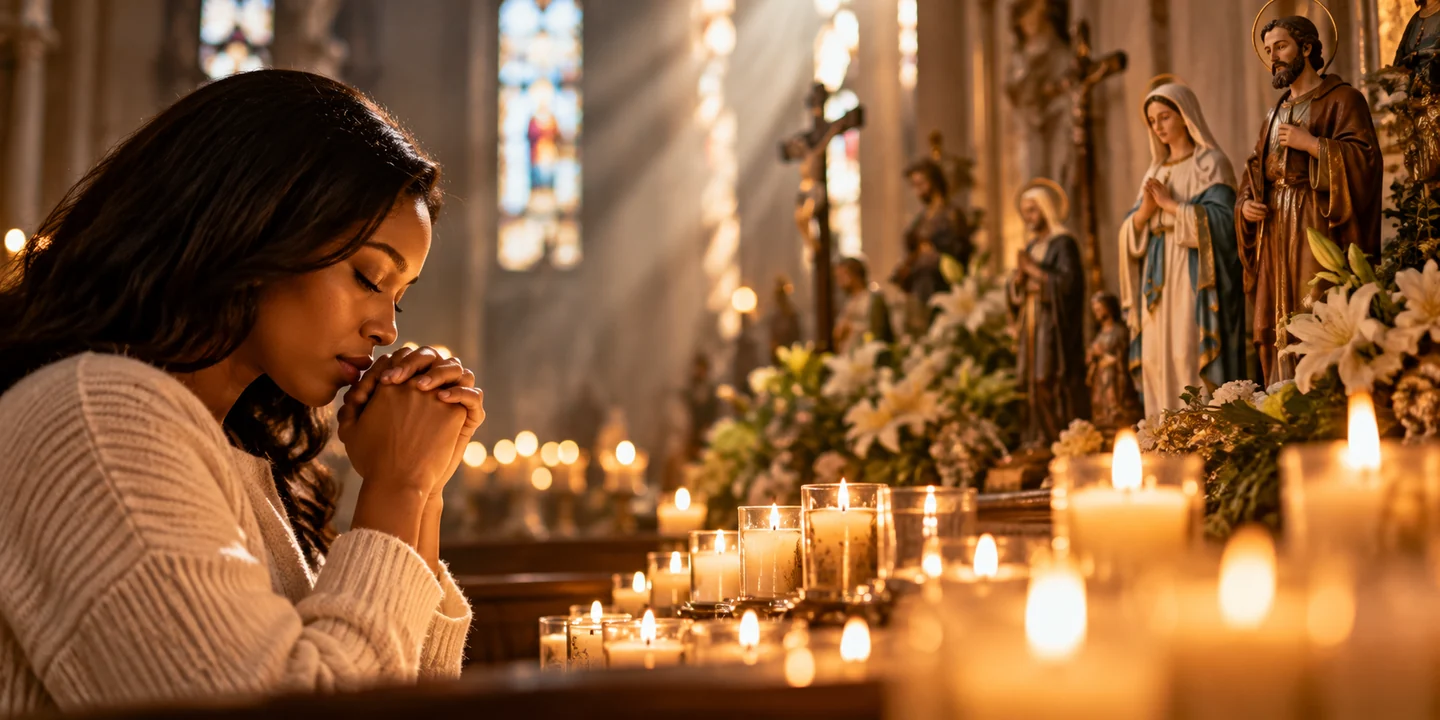
Every November, Christians around the world remember men and women whose lives were shaped by their faith in God. Some of these people are well known. Others lived quietly, serving their families, caring for their neighbours and following Christ without ever becoming famous.
All Saints' Day is a celebration of them all.
Observed on November 1 in Western Christianity, All Saints' Day honours all the saints in heaven, both known and unknown. It is especially important in the Catholic Church, although Anglicans, Lutherans and other Christian communities also observe it.
The day invites Christians to remember the example of those who have gone before them, give thanks for God's work in their lives and reflect on their own calling to holiness.
But who exactly are the saints? Why does the Church set aside a day to remember them? And what does the celebration have to do with Halloween and All Souls' Day?
To understand the feast, we need to begin with what Christians mean when they call someone a saint.
Who Are the Saints?
When people hear the word "saint," they often think of someone pictured in a church window, a person who performed miracles or a religious figure who lived hundreds of years ago.
Those associations are understandable, but they do not tell the whole story.
In the New Testament, the word translated as "saints" is used for people belonging to God. Paul addresses the Christians in Corinth as people called to be saints in 1 Corinthians 1:2.
He is writing to an ordinary Christian community, not exclusively to people who have died or been formally recognised for extraordinary holiness.
The biblical language reminds us that holiness is connected with belonging to God and living in response to His calling.
In Catholic teaching, the word "saint" also has a more specific meaning. It refers to someone who is in heaven, united with God.
Some saints are formally recognised through canonization. Others are known to God but have never been officially named by the Church.
All Saints' Day celebrates both.
Does Someone Have to Be Canonized to Be a Saint?
No. According to Catholic teaching, canonization is the Church's formal recognition that a person is in heaven and may be honoured publicly throughout the Church.
It does not mean that the Church makes someone holy or grants them entrance into heaven.
For example, Christians recognise saints such as Peter, Paul, Augustine and Francis of Assisi. Their lives and contributions to the faith have been remembered for generations.
But what about the countless Christians who lived faithfully without attracting public attention?
Consider a woman who spent much of her life caring for her family, serving people in need and practising her faith quietly. Perhaps very few people outside her community ever knew her name.
Her life would not automatically become the subject of a formal canonization process. Yet Catholic teaching does not suggest that public recognition is necessary for someone to enter heaven.
The feast therefore honours more than the saints whose names appear on church calendars. It includes all those who share eternal life with God, even when their names and stories are unknown to us.
The United States Conference of Catholic Bishops makes this distinction clear in its explanation of saints and canonization.
Why Does the Church Remember Every Saint?
The Church honours the saints for several connected reasons. The celebration is about remembering their witness, giving thanks for God's grace and looking towards the Christian hope of eternal life.
To Give Thanks for God's Work in Their Lives
In Christian teaching, holiness is not simply a personal achievement.
The saints are remembered because their lives reveal what can happen when people respond to God's grace.
Some served through teaching or preaching. Others cared for the sick, defended people facing injustice, raised families or remained faithful during persecution.
Their circumstances were different, but their lives can remind Christians that faith is meant to shape how people live.
All Saints' Day provides an opportunity to thank God for those examples rather than treating holiness as something that belongs only to the distant past.
To Remember That Holiness Is Possible in Ordinary Life
It is easy to imagine that becoming holy requires someone to abandon ordinary life and do something remarkable.
But Christians have pursued holiness in many different circumstances.
Some were priests, monks or religious sisters. Others were parents, workers, teachers, doctors and people with responsibilities that may look much like our own.
The Catholic Church teaches that all Christians are called to holiness, whatever their state of life.
That calling can be expressed in ordinary decisions: telling the truth when lying would be easier, caring for someone who cannot repay you or choosing patience in a difficult relationship.
These actions may never attract public recognition. Nevertheless, Christian faith takes seriously the importance of love and faithfulness in everyday life.
All Saints' Day invites believers to see holiness as something worth pursuing in their own circumstances.
To Remember the Christian Hope of Heaven
All Saints' Day is also a celebration of hope.
Christians believe that death does not have the final word for those united with Christ. The feast looks towards the fulfilment of God's promise of eternal life.
That does not mean grief becomes unimportant or that losing someone is easy.
Rather, the feast brings together remembrance and hope. Christians can acknowledge the pain of separation while trusting in the promise of life with God.
In Catholic teaching, the saints in heaven remain united with the Church through Christ. This relationship is part of what the Church calls the communion of saints.
The Catechism of the Catholic Church, paragraphs 946–962, explains this communion and its connection with Christian hope.
When Is All Saints' Day Celebrated?
In the Roman Catholic Church and many Western Christian traditions, All Saints' Day is celebrated every year on November 1.
In 2026, November 1 falls on a Sunday.
The date is fixed, but the weekday changes from year to year.
The Church of England also lists November 1 as All Saints' Day. Its calendar allows the celebration of All Saints' Sunday on the Sunday falling between October 30 and November 5.
Eastern Orthodox Christians have a related celebration called the Sunday of All Saints. It is observed on the first Sunday after Pentecost rather than on November 1.
Although the dates differ, these traditions share an interest in remembering those whose lives bear witness to faith in God.
How Did All Saints' Day Begin?
The history of All Saints' Day reaches back to the early centuries of Christianity.
Early Christians remembered martyrs, people who had died because of their faith. Their communities often commemorated the anniversaries of their deaths.
As the number of martyrs increased, communities also began observing collective commemorations rather than assigning an individual celebration to every person.
Evidence of common celebrations of martyrs can be found in the Christian East during the fourth century.
Over time, these observances expanded to include Christians remembered for their holiness, not only those who had suffered martyrdom.
How November 1 Became the Western Date
The date we recognise today developed gradually.
In 609 or 610, Pope Boniface IV dedicated the Pantheon in Rome as a Christian church honouring the Virgin Mary and all the martyrs. Its anniversary was celebrated on May 13.
During the eighth century, Pope Gregory III established a chapel in St Peter's Basilica dedicated to the saints. The development of the November 1 celebration in Rome is associated with this period.
In the ninth century, the observance became more widely established in Western Christianity.
The exact development of the feast involved different places and practices. It should not be described as though every Christian community began celebrating it on the same date at the same time.
The Vatican's historical overview of All Saints' Day traces the celebration from early Christian commemorations to its later development in the West.
Is All Saints' Day Mentioned in the Bible?
The Bible does not command Christians to observe an annual feast called All Saints' Day on November 1.
The celebration developed later in Christian history.
However, several biblical passages help explain the beliefs behind it.
Revelation 7:9: A Great Multitude Before God
In Revelation 7, John describes a vision of a great multitude standing before God's throne and the Lamb.
The people come from every nation, tribe and language. Their diversity is an important part of the vision.
Christians have long connected this passage with the heavenly gathering of God's people.
For All Saints' Day, it offers a picture of a community far greater than the people whose names are recorded in church history.
It also reminds us that holiness is not limited to one nationality, culture or period of history.
Matthew 5:1–12: The Beatitudes
In the Sermon on the Mount, Jesus describes the blessedness of people who are poor in spirit, merciful, pure in heart and committed to peace.
He also speaks about those who mourn, hunger for righteousness and suffer persecution.
These teachings are known as the Beatitudes.
They are especially relevant to All Saints' Day because they describe the character and way of life Jesus calls His followers to pursue.
Holiness is not presented simply as public achievement or religious reputation. It involves humility, mercy, righteousness and faithfulness.
That is why the Beatitudes are included among the Catholic Mass readings for All Saints' Day.
1 John 3:1–3: The Hope of Becoming Like Christ
First John 3 speaks about God's love and the privilege of being called His children.
It then points towards the future, when believers will see Christ and be like Him.
The passage connects Christian identity with hope and the desire to live faithfully.
It also helps explain why All Saints' Day is both a celebration of those already in heaven and an encouragement to Christians still living on earth.
Revelation 7, 1 John 3 and Matthew 5 are the main readings for the Catholic celebration of All Saints' Day in 2026.
Do Catholics Worship the Saints?
No. Catholic teaching distinguishes between the worship given to God and the honour shown to the saints.
Catholics worship God alone. They honour the saints as people whose lives reveal God's grace and provide examples of Christian faithfulness.
Catholics also believe that the saints in heaven can intercede for people on earth.
This means that asking a saint for intercession is understood as asking that saint to pray to God, not asking the saint to exercise independent divine power.
The Catechism explains this teaching in its discussion of the communion of saints and Christ's unique role as mediator.
Other Christians understand these practices differently.
Many Protestants honour the example of faithful Christians who have died but do not ask them for intercession. They generally direct their prayers to God through Jesus Christ.
These differences are important, particularly when discussing All Saints' Day with Christians from different traditions.
The celebration's emphasis on remembering Christian faithfulness does not require us to pretend that every denomination has identical teachings about prayer and the saints.
If you want to understand the biblical meaning of praying for others, read our guide to intercessory prayer and how Christians practise it.
How Do Christians Celebrate All Saints' Day?
Practices vary between churches and countries, but the central theme is remembrance and thanksgiving for the faithful who have gone before us.
In the Catholic Church
All Saints' Day is celebrated as a solemnity, one of the highest ranks of celebration in the Catholic liturgical calendar.
Catholics attend Mass, hear Scripture readings associated with the feast and give thanks for the saints.
The readings direct attention towards the hope of heaven and the call to holiness.
In some communities, families also visit churches dedicated to particular saints or spend time reflecting on the lives of people whose examples inspire them.
Local customs may include family gatherings, special prayers and activities for children.
In Anglican and Other Protestant Churches
Anglican churches commonly observe All Saints' Day through worship, Scripture readings and prayers of thanksgiving.
The emphasis often includes remembering Christians whose lives have demonstrated God's grace and encouraging believers to follow their example.
Some Lutheran and other Protestant congregations also observe the day or an All Saints' Sunday.
The precise practices differ, particularly concerning the remembrance of the dead and the intercession of saints.
Other Protestant communities do not formally observe the feast but may still teach about faithful Christians from earlier generations.
In the Eastern Orthodox Church
Eastern Orthodox Christians celebrate the Sunday of All Saints on the first Sunday after Pentecost.
The observance honours saints known and unknown, including apostles, martyrs, prophets and other faithful Christians.
Its timing after Pentecost highlights the Holy Spirit's work in the lives of God's people.
The Orthodox Church in America explains the place of this celebration in the Eastern Christian calendar.
Is All Saints' Day a Holy Day of Obligation?
Yes, All Saints' Day is a holy day of obligation for Latin-rite Catholics in the United States, subject to the country's calendar rules.
A holy day of obligation is a day when Catholics are required to participate in Mass, in addition to the ordinary Sunday obligation when applicable.
In 2026, All Saints' Day falls on Sunday, November 1. Catholics in the United States fulfil the obligation through their usual Sunday Mass. There is no additional Mass obligation simply because the feast falls on that Sunday.
Under the rules established by the United States Conference of Catholic Bishops, the separate obligation for All Saints' Day is waived when November 1 falls on a Saturday or Monday.
These rules should not automatically be applied to every country. Holy-day requirements can differ depending on the local bishops' conference and the Catholic tradition concerned.
If you're unsure whether you need to attend Mass, read our dedicated guide to whether All Saints' Day is a holy day of obligation and when Catholics must attend Mass. It explains the 2026 requirement, the US exceptions for Saturdays and Mondays, and why the rules can differ between countries.
For the official US rule, see the US bishops' complementary norms for Canon 1246.
What Is the Difference Between All Saints' Day and All Souls' Day?
These two observances appear next to each other on the Christian calendar, so it is easy to confuse them.
In Catholic teaching, however, they have distinct purposes.
| All Saints' Day | All Souls' Day |
|---|---|
| Celebrated November 1. | Observed November 2. |
| Honours all the saints in heaven. | Commemorates the faithful departed. |
| Celebrates those who share eternal life with God. | Includes prayer for the dead, particularly those undergoing purification in Catholic teaching. |
| Emphasises thanksgiving and the hope of heaven. | Emphasises remembrance, prayer and the hope of resurrection. |
All Saints' Day is not limited to people who have been canonized. It celebrates everyone believed to be in heaven.
All Souls' Day, by contrast, is particularly associated in Catholic practice with praying for the faithful departed.
The distinction can be personally meaningful.
When someone we love dies, we may remember their kindness and faith with gratitude while also acknowledging that we do not know everything about their relationship with God.
Catholic teaching encourages prayer for the departed without requiring families to declare with certainty that a loved one is already in heaven.
Different Christian traditions approach prayer for the dead differently. Anglicans, for example, also observe All Souls' Day, but their understanding and practices are not identical to Catholic teaching.
How Is All Saints' Day Connected to Halloween?
Halloween falls on October 31, the evening before All Saints' Day.
Its name developed from "All Hallows' Eve." In older English, a hallow is a holy person or saint.
This gives Halloween a direct connection with the name and date of the Christian feast.
However, modern Halloween also includes customs influenced by folklore, seasonal traditions and popular culture.
Its history is more complicated than the claim that the Church simply created All Saints' Day to replace a pagan celebration.
The Christian feast developed over several centuries, and historians continue to examine the relationship between its traditions and earlier seasonal observances.
Today, the two occasions can have very different meanings.
A family attending Mass on All Saints' Day is taking part in a Christian religious celebration. A family attending a Halloween costume party may be participating in an ordinary social activity.
They should not automatically be treated as identical.
For a closer examination of the history and biblical questions surrounding October 31, read our article on whether Christians should celebrate Halloween.
How Can You Observe All Saints' Day at Home?
If your church observes All Saints' Day, attending its services is a natural place to begin.
You can also use the day for personal or family reflection without organising anything elaborate.
Read About a Saint You Know Little About
Choose someone whose life you would like to understand better.
You might begin with a familiar figure such as Francis of Assisi, Monica or Augustine. Read about the circumstances they faced, the decisions they made and the ways their faith shaped their lives.
Rather than treating their stories as accounts of people who never struggled, consider how they responded to their weaknesses and responsibilities.
For a family activity, invite everyone to share one quality they admire and one practical way they could develop it.
Reflect on the Beatitudes
Read Matthew 5:1–12 slowly.
Consider what Jesus teaches about mercy, humility, peace and righteousness.
You might choose one of these teachings and think about a situation in which it could shape your response during the coming week.
For example, being a peacemaker may involve listening patiently during a disagreement or taking an appropriate step towards reconciliation.
If you are new to studying Scripture, our guide to studying the Bible for beginners explains how to read a passage in context and reflect on its meaning.
Give Thanks for People Who Have Influenced Your Faith
Think about people who helped you understand Christianity.
Perhaps a parent taught you to pray, a teacher helped you understand Scripture or a friend encouraged you during a difficult period.
Some may still be living. Others may have died.
You can thank God for the good they brought into your life without needing to make claims about someone's eternal state that you cannot know with certainty.
You might also consider how you can offer that same kindness or encouragement to someone else.
A Short Prayer for All Saints' Day
Heavenly Father, thank You for the lives of those who have followed You faithfully throughout the generations.
Thank You for the saints whose names are remembered by the Church and for the countless others whose lives are known to You alone.
Their examples remind us that holiness is not reserved for people who become famous. Help me recognise the opportunities to love, forgive and serve that are already part of my life.
When I am discouraged by my weaknesses, remind me of Your mercy. When I am tempted to choose what is easy over what is right, give me wisdom and courage.
Teach me to follow Jesus with humility, patience and love.
May the hope of eternal life strengthen my faith and help me bring encouragement to others.
In Jesus' name, Amen.
Frequently Asked Questions About All Saints' Day
What is All Saints' Day in simple terms?
All Saints' Day is a Christian celebration honouring all the saints in heaven, including those formally recognised by the Church and those known only to God. It is observed on November 1 in the Roman Catholic Church and many Western Christian traditions.
When is All Saints' Day in 2026?
All Saints' Day falls on Sunday, November 1, 2026. In Western Catholic practice, it is celebrated on November 1 every year.
Is All Saints' Day only for Catholics?
No. Although it has a prominent place in the Catholic calendar, All Saints' Day is also observed by Anglicans, Lutherans and some other Christian communities. Eastern Orthodox Christians celebrate a related feast on the first Sunday after Pentecost. Not every Christian denomination formally observes the occasion.
Does All Saints' Day honour only canonized saints?
No. Catholic teaching holds that the feast honours all those in heaven, including people who have never been formally canonized. Canonization is the Church's recognition of a saint, not the act that makes someone holy.
Why is All Saints' Day celebrated on November 1?
The date developed through the history of Western Christian worship. During the eighth century, Pope Gregory III established a chapel honouring the saints in St Peter's Basilica, and the November 1 celebration became associated with this period. The observance later spread more widely.
Is All Saints' Day a holy day of obligation in 2026?
For Latin-rite Catholics in the United States, All Saints' Day is a holy day of obligation. In 2026 it falls on a Sunday, so the usual Sunday Mass fulfils the obligation. Local rules may differ in other countries.
What is the difference between Halloween and All Saints' Day?
Halloween is observed on October 31 and has developed into a cultural celebration with customs such as costumes and trick or treating. All Saints' Day is a Christian religious observance on November 1 that honours the saints. The name Halloween comes from All Hallows' Eve, the evening before the feast.
A Celebration of Holiness and Hope
All Saints' Day reminds Christians that the history of their faith is much larger than the lives of its most famous figures.
Alongside the apostles, martyrs and recognised saints are countless people whose names may never appear in a history book.
The feast honours all those who share eternal life with God.
It also turns our attention towards the present. The lives of the saints invite Christians to consider how they can grow in love, mercy, humility and faithfulness.
You do not have to accomplish something extraordinary to begin responding to that calling. Sometimes the most meaningful expressions of faith happen in ordinary circumstances, through choices that few other people will ever notice.
If you want a place to begin reflecting on the feast, read Matthew 5:1–12 or Revelation 7. Both passages are part of the Catholic celebration of All Saints' Day and offer different perspectives on Christian holiness and hope.
You can find these passages in the Jesusfully online Bible.
Above all, the day reminds us that the Christian hope of heaven is connected with the way we respond to God's grace and live our faith today.