
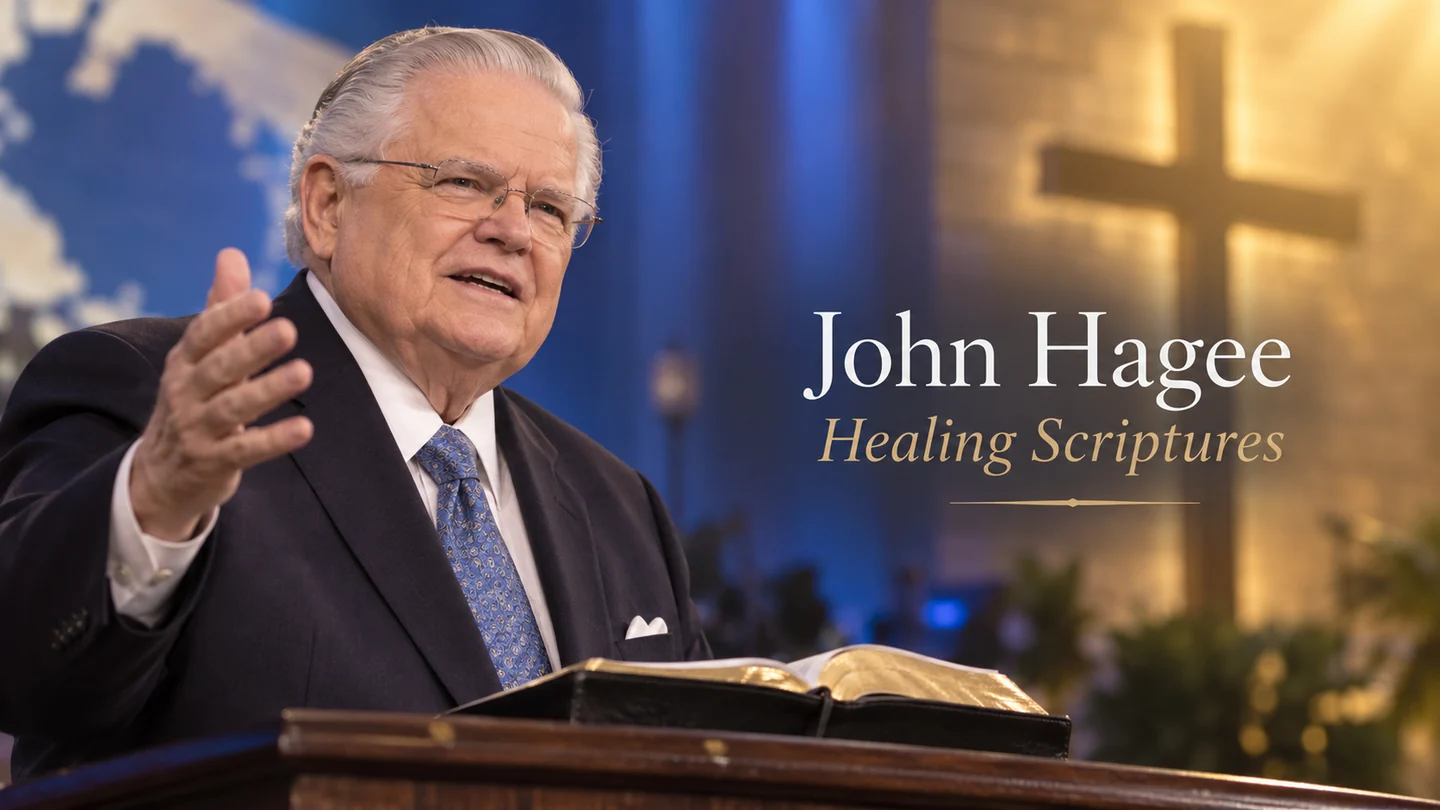
If you are searching for John Hagee healing scriptures, there is an official Hagee Ministries recording available online. In it, Pastor John Hagee reads and prays through Bible passages connected with healing, faith, hope, protection and trusting God during difficult circumstances.
This guide brings together many of the passages associated with that recording, explains what they say in context and points you to the official Hagee Ministries video so you can listen for yourself.
There is one useful distinction to make at the beginning. Hagee Ministries does not publish a complete verse-by-verse list in the description of its official YouTube video. The Scripture references in this guide were therefore checked against a detailed third-party transcription attributed to Rev. John Hagee. They are best used as a study guide rather than treated as an official Hagee Ministries transcript.
Important: prayer and Scripture can provide spiritual comfort, hope and strength during illness, but they are not a replacement for appropriate medical evaluation or treatment. If you or someone else is seriously ill, seek qualified medical care.
John Hagee’s Official Healing Scriptures Recording
Hagee Ministries published the official Healing Scriptures video with the invitation to pray along as Pastor Hagee reads Scriptures on healing.
You can find the recording on the verified Hagee Ministries YouTube channel. The video ID is 0gQILVCBH8k.
Because online uploads are sometimes copied, edited or extended by third-party channels, it is worth checking that you are using the official Hagee Ministries version if that is specifically what you want.
What Are “Healing Scriptures”?
The phrase healing Scriptures is not the name of one section of the Bible. Christians use it as a convenient way to describe passages connected with healing, God’s compassion, prayer for the sick, strength in suffering and trust in God.
These verses come from different books and historical situations. Some are prayers. Some describe God’s acts in Israel’s history. Some describe Jesus healing people. Others teach the early Church how to pray for those who are sick.
Reading them together can be encouraging, but each passage should still be understood in its own context.
Healing Scriptures to Read and Pray
| Passage | Main emphasis |
|---|---|
| Jeremiah 17:14 | A direct prayer asking God to heal and save. |
| Jeremiah 30:17 | God promising restoration and healing to His wounded people. |
| Jeremiah 33:6 | Health, healing, peace and truth in a restoration promise. |
| Psalm 103:1–5 | Remembering God’s mercy, forgiveness and healing. |
| Psalm 107:20 | God sending His word to heal and deliver. |
| Psalm 30:2 | Calling to God for help and healing. |
| Isaiah 53:4–5 | Christ’s suffering, peace and the biblical language of healing. |
| Isaiah 57:18 | Healing, guidance and comfort. |
| Exodus 15:26 | The Lord identifying Himself as healer in Israel’s covenant story. |
| Exodus 23:25 | Serving God and His care for His people. |
| Proverbs 3:5–8 | Trusting God, walking wisely and the language of health. |
| Romans 8:11 | The Spirit of God giving life. |
| James 5:14–15 | Prayer for those who are sick. |
| 1 Peter 2:24 | Christ bearing sin and bringing healing. |
| 3 John 1:2 | A prayer for health and wellbeing. |
Reading the Key Healing Passages in Context
Jeremiah 17:14 — a simple prayer for healing
Jeremiah 17:14 is one of the clearest examples of a person directly asking God for healing.
The verse is valuable because it does not need complicated interpretation before it can become a prayer. Jeremiah is speaking to God honestly and recognising Him as the source of salvation.
You might pray it in your own words:
Lord, I need Your help. I ask You for healing and for the grace to trust You while I seek the care I need. Give me strength for today and wisdom for every decision ahead.
Psalm 103 — remembering God’s compassion
Psalm 103 calls the worshipper not to forget God’s benefits. It speaks of forgiveness, healing, redemption, compassion and steadfast love.
The psalm is not a promise that every believer will avoid sickness in this life. Its purpose is larger: it celebrates the character and mercy of God.
When you are ill, fear can narrow your attention until the diagnosis becomes the only thing you can see. Psalm 103 can help you remember that your relationship with God includes more than one immediate circumstance.
Isaiah 53 — “By His wounds we are healed”
Isaiah 53 is one of the most quoted passages in Christian discussions of healing.
The chapter describes the suffering servant who bears griefs and sins. The New Testament applies this passage to Jesus.
First Peter 2:24 quotes the language of being healed by Christ’s wounds while speaking explicitly about sin and righteousness. Matthew 8:16–17 also cites Isaiah when describing Jesus’ ministry of physical healing.
That means Christians should resist reducing Isaiah 53 to only one dimension. The passage belongs to the larger biblical message of Christ’s suffering, sin, salvation and the restoration God brings.
Jesus’ healing ministry in the Gospels
The Gospels repeatedly show Jesus responding to sick and suffering people.
| Passage | What happens |
|---|---|
| Matthew 8:1–4 | Jesus heals a man with leprosy and tells him to follow the required testimony to the priest. |
| Matthew 8:5–13 | A centurion asks Jesus to heal his servant, expressing confidence in Jesus’ authority. |
| Mark 2:1–12 | Jesus forgives and heals a paralysed man, connecting the miracle with His authority to forgive sins. |
| Mark 5:21–43 | Jesus responds both to a woman with long-term illness and to Jairus’ daughter. |
| John 9 | Jesus heals a man blind from birth and rejects the simplistic idea that his condition must be punishment for a specific sin. |
These accounts reveal Jesus’ compassion and authority. They should not be used to shame a sick person by claiming that continued illness automatically proves insufficient faith.
Healing in the Book of Acts
Acts also records healings connected with the ministry of the apostles.
In Acts 3, Peter and John encounter a man unable to walk. His healing becomes an opportunity to point people towards Jesus rather than towards the apostles themselves.
Acts 9 describes Peter praying before Tabitha is restored to life. Acts 14 records a man in Lystra being healed during Paul’s ministry.
The emphasis remains on God’s power and the message of Christ—not on turning Christian ministry into a technique for producing miracles on demand.
James 5 and Prayer for the Sick
James 5:14–16 gives practical instruction to the Christian community. A sick person is encouraged to call the elders of the church, who pray and anoint with oil in the name of the Lord.
The passage connects prayer, community, confession and care. It is noticeably different from an isolated individual trying to manufacture enough faith alone.
If your church has a practice of anointing the sick or pastoral prayer, this passage is one reason for it.
When Healing Does Not Come Immediately
This is one of the most important questions a healing-Scripture article can address.
The Bible includes remarkable healings, but it also includes faithful believers who experience weakness, suffering and unanswered requests.
Paul speaks in 2 Corinthians 12 about repeatedly asking for his “thorn in the flesh” to be removed. The answer he records is not removal but grace sufficient for weakness.
In 1 Timothy 5:23, Paul gives Timothy practical advice concerning recurring stomach problems. Epaphroditus becomes seriously ill in Philippians 2. Trophimus is left sick in Miletus in 2 Timothy 4:20.
Those passages keep Christians from making cruel conclusions about someone whose illness continues.
You can pray confidently for healing while also acknowledging that you do not control the timing or outcome.
Prayer and medical treatment are not enemies
No. Trusting God and receiving medical care do not need to be enemies.
Luke, one of Paul’s companions, is called “the beloved physician” in Colossians 4:14. The Bible includes practical care alongside prayer.
If medication, surgery, counselling, physical therapy or another treatment is recommended by qualified professionals, accepting appropriate care does not demonstrate a lack of faith.
A responsible healing prayer can include doctors, nurses, caregivers and the decisions involved in treatment.
How to Use John Hagee Healing Scriptures in Your Prayer Time
If you use the Hagee Ministries recording or another Scripture-reading resource, you can make the time more thoughtful with a few simple habits.
- Keep your Bible open. When a verse stands out, read the surrounding paragraph or chapter.
- Pause when needed. You do not have to finish a long recording in one sitting.
- Pray honestly. Tell God where you are frightened, tired or uncertain.
- Write down a few passages. Choose Scriptures you want to revisit rather than trying to remember dozens at once.
- Pray for practical care. Ask for wisdom for medical professionals and good decisions about treatment.
- Avoid formulas. Scripture is not an incantation. Repeating a verse does not place God under an obligation to produce a particular outcome.
A Healing Prayer With Scripture
Heavenly Father, You know everything happening in my body and mind. Nothing about this illness is hidden from You.
I ask You for healing. Give strength where I am weak, peace where I am afraid and wisdom for every decision that needs to be made.
As Jeremiah prayed, heal me, Lord, and I shall be healed; save me, and I shall be saved. Help me remember Your compassion in Psalm 103 and the grace You give when strength feels limited.
Guide the doctors, nurses and everyone involved in my care. Protect me from fear-driven decisions and from advice that is unsafe or dishonest.
If recovery takes time, give me patience for the process. If the outcome is different from what I hope, keep me close to You and surround me with people who will walk with me faithfully.
I place my life in Your hands and ask for Your mercy in Jesus’ name. Amen.
Praying for someone else who is sick
You can adapt healing Scriptures when praying for a friend or family member without making promises on God’s behalf.
For example:
Lord, I bring my friend before You. Please bring healing and relief. Give wisdom to the medical team, strength to the family and peace during the uncertainty. Help me know how to support them in practical ways. Amen.
Our longer guide to prayer for healing and recovery for someone who is sick includes additional prayers and biblical context.
Listening while resting or sleeping
Some people find quiet Scripture audio calming at night. There is nothing inherently wrong with listening while resting if it helps create a peaceful environment.
But the spiritual value of Scripture is not based on audio playing unconsciously for a certain number of hours. The Bible repeatedly encourages understanding, meditation, faith and obedience.
When possible, spend some waking time actually reading and considering the passages too.
Healing Scriptures is not a separate Bible translation
No. “Healing Scriptures” describes a collection or reading of biblical passages, not a separate Bible translation.
If you want to check wording or context, look up the references in a recognised Bible translation. You can also use the Yours Jesusfully Bible when that feature is available.
Is There an Official John Hagee Healing Scriptures PDF?
During the original research for this article, the official Hagee Ministries video and official recorded resources were easy to verify, but we did not find an official free PDF containing a complete Healing Scriptures transcript.
Several websites publish their own lists under names such as “John Hagee healing scriptures PDF.” Those lists may help readers locate verses, but they should not automatically be described as official Hagee Ministries material. If you want the original resource, the safest option is the ministry’s own video or material distributed by Hagee Ministries.
Frequently Asked Questions
What is the official John Hagee Healing Scriptures video?
Hagee Ministries published a verified YouTube video titled Healing Scriptures. Its video ID is 0gQILVCBH8k.
What is a good Bible verse to pray for healing?
Jeremiah 17:14 is a direct prayer for healing. Psalm 103:1–5, James 5:14–16 and passages describing Jesus’ healing ministry are also commonly used.
Does Isaiah 53 promise that every Christian will be physically healed immediately?
Christians interpret the healing language in Isaiah 53 within the larger work of Christ, including sin and salvation. The New Testament applies the passage in more than one context. It should not be used to condemn a sick Christian whose recovery is delayed or incomplete.
Can I pray for healing and still take medicine?
Yes. Prayer and appropriate medical care can be pursued together.
Does sickness mean I do not have enough faith?
No. Scripture contains faithful people who experienced ongoing illness and weakness. Illness should not automatically be treated as proof of spiritual failure.
Can I use this article as a substitute for medical advice?
No. This is a Christian devotional and Bible-study resource, not medical guidance. Seek qualified healthcare for diagnosis and treatment.
Source note: The official Healing Scriptures video and recorded resource are published by Hagee Ministries. The official video description does not provide a complete Scripture list. Bible references in this guide were cross-checked against a third-party transcription specifically attributed to Rev. John Hagee; this article does not claim that transcription itself is an official Hagee Ministries publication.
Read Healing Scriptures With Hope and Context
Healing passages can be deeply comforting, especially when illness leaves you frightened or exhausted. The goal, however, is not merely to collect verses that sound reassuring.
Read them in context. Notice God’s compassion. Notice Jesus’ care for suffering people. Notice the Church praying together. Notice also the biblical honesty about weakness and waiting.
You can ask God boldly for healing while receiving medical care, supporting others and trusting Him with the part of the story you cannot control.