The Lumber Baron’s Wife (Book Review + Free PDF)
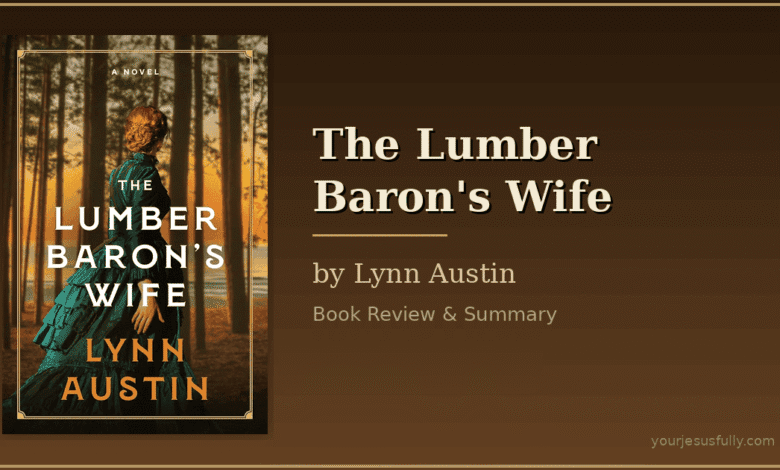
If you have ever picked up a Christian novel hoping for a story that feels real, you know how rare that can be. Too often, the characters seem too perfect, the problems too tidy, and the ending too predictable.
That is why I was surprised by The Lumber Baron’s Wife by Lynn Austin. It is one of those books that stays with you after the last page. Not because everything wraps up in a neat bow, but because it faces hard things honestly and still leaves you with hope.
Lynn Austin is not a new name in Christian fiction. She has sold millions of copies, won eight Christy Awards, and even had one of her books turned into a Hallmark movie. But this novel feels different from her earlier work.
It is set in the lumber boom towns of 1870s Michigan. It is built around a real mystery: the true, unsolved disappearance of a lumber baron’s wife. Austin and her husband actually live in western Michigan, and you can tell she wrote this story with love for the land and its forgotten history.
The book came out in April 2026 from Tyndale House, and it runs about 368 pages. It is a dual-timeline story, which means you get two narratives woven together. One takes place in 1873, and the other happens in the present day.
I know some readers groan when they hear “dual timeline,” but this one works because both stories are equally strong. You are not tempted to skip ahead to get back to the “good” part. Both timelines are the good part.
What makes this book worth your time is how it handles heavy topics without getting preachy. It deals with child loss, domestic abuse, abortion, and grief. Those are not easy subjects to write about, especially in a way that honors both the pain and the truth of Scripture.
Austin manages it by letting the characters wrestle out loud with their questions. If you have ever wondered where God is when your life is falling apart, you will find company in these pages. The faith element feels earned, not forced.
This is also a great pick if your book club is looking for something with meat on the bones. The paperback includes discussion questions, and there is plenty to talk about without the conversation turning into a sermon. The mystery keeps you turning pages, but the relationships are what make you care.
Full Summary of The Lumber Baron’s Wife
The story opens in 1873 with Hannah Wagner, a woman who cannot sleep because her friend has vanished. Kate Abernathy, the young wife of a wealthy lumber baron, disappeared two weeks ago without a trace. Hannah fears the worst, and as the story unfolds, you understand why.
Hannah and her husband John have just suffered every parent’s nightmare. All three of their children died from illness. The grief has swallowed Hannah whole.
She is angry at God, distant from her husband, and barely functioning in their New York City home. When Henry Abernathy, an old friend from John’s Civil War days, offers John a job as the town doctor in a booming Michigan lumber settlement, it feels like an escape plan. Henry will even build them a house.
Hannah does not want to go, but she has nothing left to stay for. So she follows John into the wilderness, leaving behind the graves of her children and every familiar thing she knew.
The town is rough. It is filled with lumberjacks, fortune seekers, and men trying to get rich quick from Michigan’s white pine forests. At the top of the social ladder sits Henry Abernathy, whose mansion overlooks everyone else’s modest homes.
But the real talk of the town is his new wife, Kate. She is much younger than Henry, beautiful, and completely out of place. Kate grew up in a brothel and worked as an actress and dancer. She does not know the rules of high society, and she does not seem to care.
She wears dresses that show too much skin, speaks her mind, and treats her own home like a stage. Henry wants respectability, so he asks Hannah to teach Kate how to be a proper lady.
Hannah wants nothing to do with the assignment at first. She is too deep in her own sorrow to care about etiquette lessons. But slowly, the two women form a bond.
Hannah sees past Kate’s bold exterior to the wounded person underneath. Kate has secrets about her former life that could destroy her marriage and her safety. As Hannah gets closer to her, she realizes that Henry is not just socially ambitious.
He is controlling, quick-tempered, and dangerous. The marriage that looks glamorous from the outside is cracking under the weight of his demands.
Then a fire tears through part of the town. In the chaos, Kate Abernathy disappears. No one finds a body. No one has answers. The mystery of what happened to her becomes the town’s ghost story, the thing people whisper about for generations.
The novel then shifts to the present day. Ashley Gilbert and her husband David have just moved to the same Lake Michigan town. David landed his dream job as a conservationist, but for Ashley, a historian and museum specialist, the move feels like a step backward.
She gave up her career momentum so David could chase his calling, and the resentment is starting to show. They buy an old nineteenth-century house, the same one originally built for Hannah and John Wagner, and Ashley begins to feel like the walls are trying to tell her something.
She volunteers to help restore the old Abernathy mansion, which is being turned into a museum. As she strips wallpaper, digs through archives, and pieces together the past, she stumbles onto the unsolved mystery of Kate’s disappearance.
What starts as a professional curiosity turns into a personal obsession. The more Ashley learns about Kate and Hannah, the more she recognizes herself in their struggles. She sees her own marriage strain, her own questions about sacrifice and identity, and her own need to make sense of a story that was buried for over a century.
Ashley is also dealing with an unexpected pregnancy, which forces her and David into conversations they have been avoiding. Like Hannah before her, Ashley has to figure out what it means to trust her husband when everything feels uncertain.
The old house and the old mansion become symbols of something bigger. They remind us that restoration takes time, that hidden damage has to be uncovered before it can be fixed, and that God is still writing stories in the places we think are ruined.
The three women—Hannah, Kate, and Ashley—never meet, but their stories speak to each other across time. Hannah’s journey is about learning to live again after loss. Kate’s story is about whether a past full of shame can be rewritten.
Ashley’s story is about choosing to believe that her life matters even when her plans fall apart. When the truth about Kate finally comes to light, it is not the ending you might expect, but it is the ending the story earns.
Austin gives even the hardest characters a shot at redemption. She presents the Gospel through a simple courtroom scene that lands with real emotional weight.
If you are someone who loves historical fiction with a mystery at its center, this one delivers. If you are walking through a season of grief, marriage struggle, or spiritual doubt, you will find characters who understand. And if you are simply looking for a well-told story that respects your intelligence while still pointing you toward Christ, The Lumber Baron’s Wife is worth the read.